

Why a Bachelor in Cyber Security Is a Smart Choice for the Future
Discover why a Bachelor’s in Cyber Security can prepare you for an exciting, practical, and future-focused career in Nepal and beyond.
In the current era, digital security is one of the most sought-after career fields. Organisations across every industry need qualified professionals to protect sensitive information, secure systems and respond to evolving cyber threats. A Bachelor's in Cyber Security is more than just a degree. It provides the knowledge and practical skills needed for a rewarding and future-focused career.
A common concern among many students is whether this course will still be relevant in the face of advancing technology. Yes, indeed. With the increasing number of career opportunities, Fishtail Mountain College’s BSc (Hons) Cyber Security course is designed to provide practical knowledge on ethical hacking, digital forensics and cyber security.
Why Students Choose Cyber Security
Most students gravitate towards the subject area of cybersecurity due to its direct connection between education and career prospects. This is a discipline for people with an interest in solving problems and investigating how systems can be kept safe from any potential threats. Unlike other courses that may seem overly academic, cybersecurity is more practical and in high demand.
A cybersecurity degree is a strong choice for students who want:
- A career with strong industry demand.
- Practical technical learning instead of theory alone.
- Skills that apply across many sectors.
- A route into ethical hacking, cloud security or security operations roles.
- Opportunities in Nepal and international job markets.

What Will You Learn in a Cybersecurity Course
A good cybersecurity course will provide students with comprehensive knowledge of the measures that help protect systems, networks, applications, and data. The aim is to train the students to secure the digital environments which are used every day by organisations. This involves threat identification, access protection, incident analysis, and attack response.
Students can expect to build skills in:
- Ethical hacking and vulnerability assessment.
- Digital forensics and incident investigation.
- Cyber defence and security operations.
- Network and system protection.
- Access control and data security.
- Risk awareness and secure system thinking.
Such skills are important because any organisation is at risk of a cyberattack. If this occurs, the operations of the organisation become slow, and there is a loss of customer confidence. Cybersecurity specialists protect organisations from such risks.
Career Opportunities After Graduation
One of students' primary concerns relates to whether the qualification will result in a job. The field of cybersecurity has tremendous job prospects due to the requirement for secure systems across all industries.
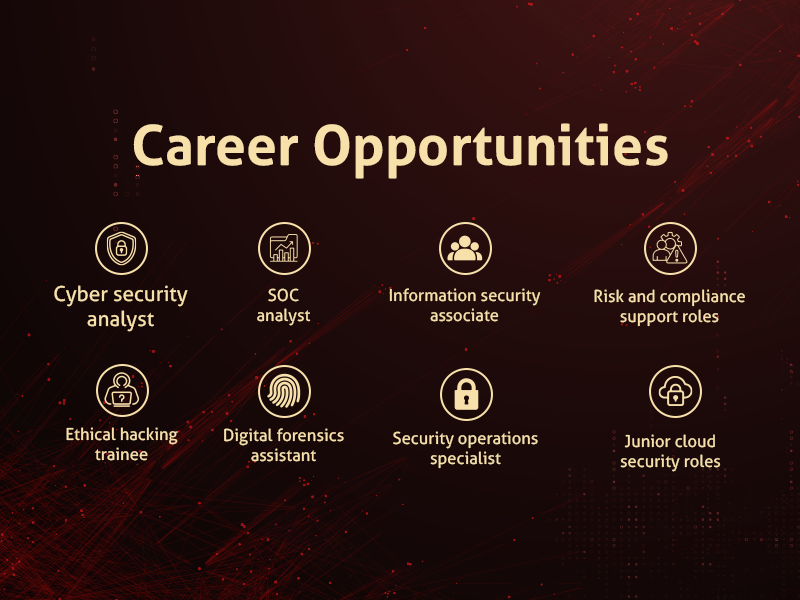
Possible career paths include :
- Cybersecurity analyst.
- SOC analyst.
- Information security associate.
- Ethical hacking trainee.
- Digital forensics assistant.
- Security operations specialist.
- Risk and compliance support roles.
- Junior cloud security roles.
The field is also a strong starting point for students who want to specialise later. Cybersecurity connects naturally to cloud security, networking, digital forensics, governance and enterprise IT. The skills learned in this degree can support both local and global career growth.
Why Cyber Security Still Matters in an AI-Driven World
While AI is revolutionising many industries, it poses new threats, new ways of attacking systems and new cybersecurity issues. Intelligent systems, interconnected devices, cloud computing solutions and data-intensive systems are all vulnerable and require adequate protection. Therefore, cybersecurity is not going away with the rise of AI; on the contrary, it becomes even more crucial given the increasing complexity of digital solutions.
A cybersecurity degree can help students understand and answer questions such as:
- How do organisations detect and prevent cyber attacks?
- How can digital systems stay secure from threats?
- How can sensitive data be protected?
- How can investigators analyse incidents after an attack?
- How can businesses reduce risks in cloud and connected environments?
- How can security teams respond faster and smarter?
For students interested in AI, cybersecurity provides the protection layer behind the technology. AI may power modern tools, but cybersecurity keeps those tools safe, trustworthy and resilient.
Common Student Concerns
Students usually feel that this topic of cybersecurity is very technical, very specialised or difficult to learn. Some students are even afraid that they might be too competitive or might require prior experience. This might be true in some cases; however, a good programme will teach the topic gradually and build up confidence in students.
A strong programme should address these pain points by offering:
- Clear explanations for beginners.
- Hands-on labs and practical exercises.
- Exposure to real security environments.
- Career guidance and job-oriented learning.
- Skills that stay relevant as technology changes.
Students also want confidence that they will graduate ready for work. That is why practical experience matters so much in cybersecurity. The more students practise analysis, defence and incident response tasks, the easier it becomes to step into a real workplace.
Why It Is a Smart Choice in Nepal
As the digital environment in Nepal expands, there is an increasing demand for professionals in the field of cybersecurity. Banks, telecoms, universities, hospitals, startup companies, and the government require robust IT security in order to protect their systems and data. Hence, there are opportunities for graduates who can safeguard infrastructure and help run digital systems.
Cybersecurity is another great option for those looking for flexibility. The skills learned can be applied in different fields and may lead to jobs in Nepal or anywhere else in the world. This programme will benefit any student who desires job security and growth opportunities.
Final Thought
A Bachelor’s in Cybersecurity is a practical investment for students who want a career in technology
without limiting themselves to one narrow path. It builds the foundation for jobs in defence,
analysis, forensics and security operations while also opening the door to cloud and advanced IT
specialisations later. For students looking for a future-ready tech degree, cyber security remains
one of the strongest choices.